Hradčany — tipos de desenho I–Va
seis tipos de desenho; a espiral, a barra e a moldura são sinais do desenho V
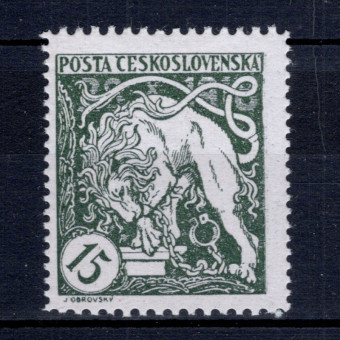
Os valores dos Hradčany existem em seis tipos de desenho (I, II, III, IV, V e Va) — não em cinco. No desenho V, o mais difundido, distinguem-se ainda subtipos mais finos conforme a espiral, a barra, o arco e a moldura; cada um está ligado a uma posição específica da folha e pode alterar o preço em ordens de grandeza. Determine o tipo comparando com as ilustrações do Pofis (a Monografia reproduz as folhas de todas as chapas em escala 1:1); nas peças duvidosas, um perito pode ajudar.
Hradčany — colour shades (especially the 15 h)
the 15 h in five shades · the 5 h by plate
Several values have priced colour shades. The most pronounced is the 15 h (Pof. 7), which exists in five shades — brick-red, brown-red, red, carmine and vermilion — with order-of-magnitude price differences. On the 5 h the shade (blue-green / dark blue-green / dark green) is tied to the printing plate. Judge shades in indirect daylight against a reference copy; scanners and screens distort colour. Shades are the prime target of chemical and light manipulation — a dearer shade is worth having verified.
Hradčany — determining the spiral (type I / II)
open vs closed spiral · design V
On design V the spiral in the ornament is distinguished: type I s has an open spiral, type II s a closed one. The feature is tied to a specific sheet position and underlies the joined types (STs) — undivided pairs of different types are worth considerably more. Determine the spiral under magnification against a reference illustration of the value and plate concerned.
Hradčany — determining the bar (type I / II / IIa)
short, long and incomplete bar
The second feature of design V is the bar: type I p has a short bar, type II p a long one, subtype IIa p an incomplete one. On some values the arc is also distinguished (missing / complete / incomplete), which Pofis does not yet price. As with the spiral, the bar underlies the joined types (STp) at a higher price. Determine it under magnification against a reference position.
Hradčany — the frame type (type I / II)
broken vs unbroken frame · 10 h, 75 h, 500 h
On the 10 h, 75 h and 500 h values the frame is distinguished: type I r has a broken frame, type II r an unbroken one. Joined types (STr) exist here too — undivided pairs of the two types. The frame is a fine feature at the edge of the design; determine it under magnification against a reference illustration of the value.
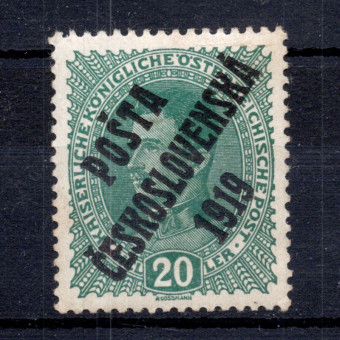
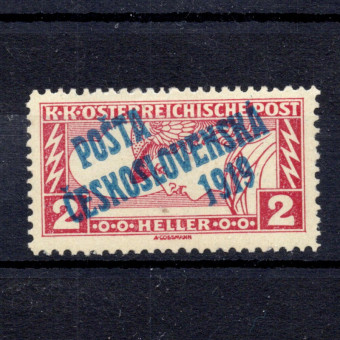
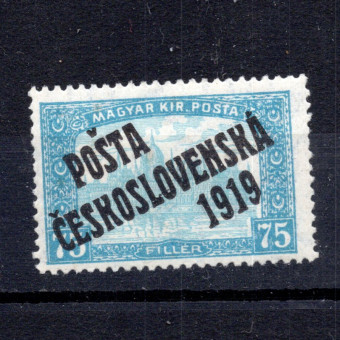
PČ 1919 — overprint classes and types
seven overprint classes A–G, not three formats
The 1919 overprint is told apart not by the stamp’s size but by the overprint itself: there are seven classes A–G, each in several types and subtypes. They are determined from the overprint’s dimensions and letter shapes (heart-shaped háček, serifs, trimmed digits, open/closed “K”) and from which values they occur on. Classes D and F share identical dimensions and differ only by the range of catalogue numbers; class E has a single distinguishing mark. A wrong-class overprint on a given value is a forgery; for dearer pieces consult an expert.