Postage prices 2026: how much is a stamp for a letter?
How much does a stamp for a letter cost in 2026? The short answer up front: you can send a standard letter up to 50 g for 31 Kč (a B stamp), a priority letter for 36 Kč (an A stamp), a postcard or letter to Europe for 48 Kč (an E stamp) and outside Europe for 54 Kč (a Z stamp). The prices of letter stamps in 2026 did not change — but registered and insured letters did go up. This article gives you the complete overview, a comparison with eighteen countries of Europe and with overseas markets, and an estimate of what awaits postage in 2027.
2026 stamp prices at a glance
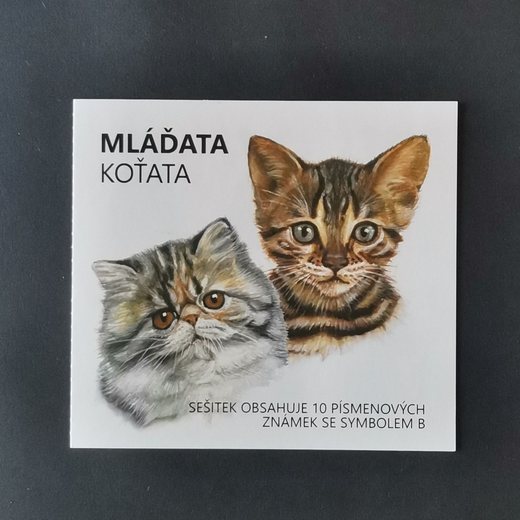
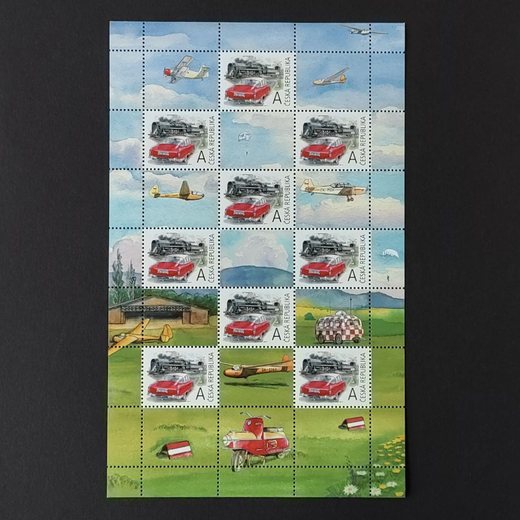
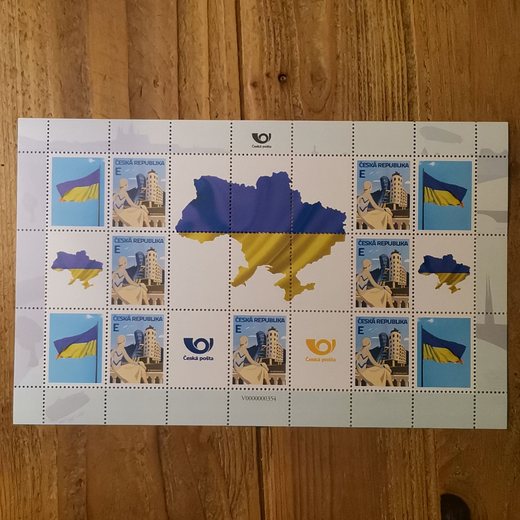

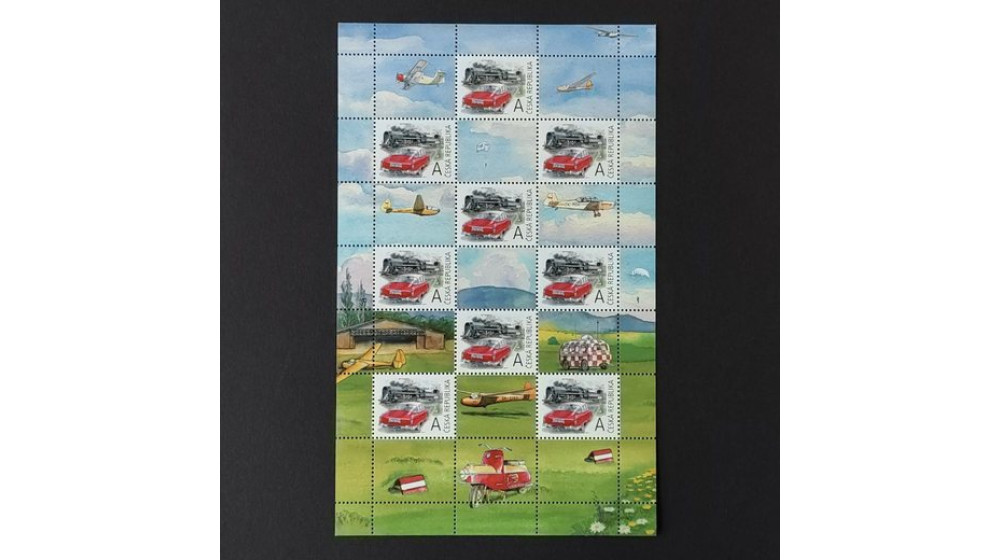
This is what the letter stamps look like in our range — click through to the individual item. The complete overview is in the section Czech Republic stamps.
What changed in 2026
Czech Post revised its price list three times during 2026 — in January, in April and in July. None of those changes touched ordinary letter stamps, however. The increases mainly hit services with confirmed delivery:
The registered and insured letter prices apply from 1 April 2026. In addition, SIPO payments ceased to be exempt from VAT in January 2026, so 21 % is now added to them.
How prices climbed: from the founding of the republic to today
A look at history shows why it pays to buy stamps in advance. When Czech Post was founded in 1993, the cheapest letter cost 3 Kč. Today it is 31 Kč — more than ten times as much:
The turning point came in 2010, when Czech Post introduced letter stamps with no koruna value printed on them. Since then a price rise no longer requires new face values to be printed — and holders of old letter stamps pay nothing extra.
The pace is quickening, though. Between 1993 and 2008 the price rose from 3 to 10 Kč (that is, over fifteen years), whereas the latest jump from 19 to 31 Kč took a mere seven years. In the inflationary period of 2022–2023 alone the post raised prices three times:
The main driver behind the increases is the collapse in traditional mail volumes. Letter items are falling by roughly 15 % a year — yet the fixed costs of the delivery network remain, so the post spreads them across an ever smaller number of letters. It is a vicious circle that postal operators across Europe are wrestling with.
What a letter costs elsewhere in Europe
Rising prices are not a Czech story alone — postal operators across Europe are facing the same problem: letter volumes are falling, but the delivery network has to be maintained. The comparison below shows the basic domestic letter in eighteen European countries, converted at the Czech National Bank rate of 18 August 2026. For each country we also link to its section in our shop.
Converted at the Czech National Bank rate of 18 August 2026 (1 € = 24.18 Kč; 1 zł = 5.60 Kč; 1 DKK = 3.23 Kč; 1 SEK = 2.19 Kč; 100 Ft = 6.64 Kč). For Germany we give both the Standardbrief up to 20 g and the Kompaktbrief up to 50 g, which is comparable by weight with the Czech B stamp. The Polish S format applies all the way up to 500 g. The country names link to our range of stamps from that country.
And what about overseas? The USA, Brazil and Argentina
Our shop has customers outside Europe too, so we have added three large overseas markets. With these it is interesting to watch both rates at once — what a letter costs at home and what it costs to send to Europe:
Converted at the Czech National Bank rate of 18 August 2026 (1 $ = 20.89 Kč; 1 R$ = 4.01 Kč). The Czech National Bank does not quote the Argentine peso, so that conversion is indicative, based on the market rate, and changes rapidly given inflation; Correo Argentino also gives no effective date for its price list.
- An American postcard to Europe costs the same as a letter. USPS has a single worldwide rate of 1,75 $ regardless of destination, and there is no cheaper tariff for international postcards — unlike domestic ones, which cost 0,65 $. For postcrossers in the USA that means the full letter rate for every card.
- Brazil has a social tariff costing one centavo. Alongside the ordinary rate of 2,65 R$ there is Carta Social at 0,01 R$ — the cheapest postal rate in this entire comparison. Watch the zoning as well: mainland Portugal falls into group 4, the same as Czechia, but the Brazilian post places the Azores and Madeira in the more expensive group 5.
- Argentina has no letter step up to 20 grams. The lowest domestic step only begins at 100 g, so the comparison with Europe is not quite like for like. An international item there costs 2.6 times the domestic rate — and a registered letter to Europe as much as six times.
Three trends that are reshaping the European post
1. Priority mail is disappearing — or turning into a surcharge
Fast delivery is ceasing to be the standard and is turning into a premium service. France abolished the priority letter back in 2023; the standard item today is Lettre verte with delivery within three days. Italy abolished priority mail entirely on 1 May 2026 — the budget act removed it from the universal service and the standard item has a five-day delivery standard. Netherlands on 12 July 2026 shifted its delivery standard from the second day to the third. Austria is taking a different route: the basic letter costs 1 €, but delivery the very next day carries a surcharge of 0,90 €. Czech Post did exactly the same in April 2026 — it simply kept the A stamp as a separate product.
2. Denmark simply abolished its post
The most dramatic example came from Scandinavia. The Danish PostNord delivered its last letter on 30 December 2025 and left the letter market after 401 years. Delivery has been taken over by the private company dao. Danish PostNord stamps have ceased to be valid and unused ones are being refunded for a limited period. For collectors this is a milestone: one of the oldest postal administrations in Europe has come to an end — and its stamps have suddenly become a closed collecting chapter.
3. Volumes are falling faster than prices can rise
Behind it all lies a single number. In Czechia letter items are falling by roughly 15 % a year. France's La Poste delivered seventeen billion letters in 2005; in 2025 it was only 5.6 billion — and by 2030 it expects a mere three billion. Since 2008 the Austrian post has lost roughly 60 % of its letter items and in 2025 alone it lost a further 8 %. The costs of the delivery network remain, however, and have to be spread over an ever smaller number of items. The European Commission is therefore preparing a new regulation on delivery services for the end of 2026; in its explanatory memorandum it states openly that the existing funding of the universal service is “progressively unsustainable”.
Insured letters: for collectors, everything changed in 2026
The insured letter used to be a given for philatelists — it was how stamps and covers were sent with insurance against loss. Since 2026, however, it has not been that simple. If you send stamps abroad, this is the most important part of the article.
The second catch: the post excludes liability for collectors' items
Even if the item did get through, there is one further provision. For the vast majority of countries (you will find it on the pages of 159 of the 223 countries in the International Conditions) it states that if the item contains “objects of cultural, artistic or collectors' value regardless of their age and price”, then for damage arising from loss or damage the undertaking is not liable. In practice this means that you do pay a surcharge for the declared value, but if the stamps are lost you may get nothing from it. The exception among the countries we checked is Netherlands, where this clause is missing.
Where an insured letter can go at all
Of the roughly 227 countries in the Czech Post overview, the insured letter can be selected for only 87 of them — and most of the big markets are missing from among them. An insured letter cannot be sent to Germany, the USA, the United Kingdom, Spain, Switzerland, Belgium, Norway, Hungary, Canada or Australia. It does work to these countries, for example (the maximum possible declared value is in brackets):
The ceiling of 121,022 Kč corresponds to the limit of 4,000 SDR at the special drawing rights rate for 2026. The complete list is in the Czech Post International Conditions.
What an insured letter costs
Prices according to the Czech Post price list in force from 1 July 2026. A declared-value surcharge is added to the price: for international items 4 Kč for every 1,000 Kč or part thereof, for domestic items 6 Kč up to a value of 5,000 Kč and 14 Kč up to 30,000 Kč. Domestically a value of up to 1,000,000 Kč may be declared. Watch out with the registered letter: the post is liable for it only up to 908 Kč, even with an advice of receipt.
So how do you send stamps abroad
Summed up as a practical procedure:
- Low-value items — a standard letter abroad with an E stamp from 48 Kč. No tracking and no liability on the part of the post, but the cheapest option.
- Mid-range value — Insured parcel. Where an insured letter is not available, it is usually the only insured route. Watch the ceilings: only 12,102 Kč to Germany, as little as 3,025 Kč to Switzerland, and 104,320 Kč to the USA.
- Higher value or a problematic destination — for the United Kingdom, Belgium, Norway, Canada and Israel, Czech Post has no service with insurance beyond the flat-rate compensation. There a commercial carrier is the right choice.
- Within Czechia everything stays as it was: an insured letter for 88 Kč with a declared value of up to a million koruna.
When to reach for a courier
For more valuable items, or for countries to which Czech Post offers no insured service, a commercial carrier is worth it. Collectors' items tend to have a special regime with them too, so always check the insurance conditions in advance — a number of carriers exclude them from basic cover just as the post does.
- DHL Express, UPS, FedEx — the fastest international delivery with tracking. Suitable for more valuable items where reliability and clearly defined carrier liability are decisive.
- Shipping comparison sites such as Zaslat.cz and similar aggregators compare the prices of several carriers at once. For one-off items sent abroad they often work out cheaper than ordering directly from a courier.
- Balíkovna and pick-up points (Packeta, PPL ParcelShop, DPD) — the cheaper option for items within Czechia and to Slovakia.
What to expect in 2027?
Czech Post has not yet published its price list for 2027 and, as of August 2026, has announced no increase in letter stamp prices. Elsewhere in Europe, though, the cards are already on the table — and those moves hint at what awaits us too.
France: the increase is confirmed
La Poste has announced a tariff increase of 6.73 % from 1 January 2027. The basic Lettre verte will rise from 1,52 € to 1,67 € (+9.9 %), the registered letter from 6,11 € to 6,47 € and the international letter up to 20 g from 2,25 € to 2,45 €. Converted, the French will therefore pay over 40 Kč for an ordinary letter — a third more than we do.
Germany: the decision will come by the end of the year
The German Standardbrief has held its price of 0,95 € since January 2025, because the regulatory period set by the Federal Network Agency runs until 31 December 2026. The new pricing procedure began in January 2026 and the decision is expected at the end of the year. Deutsche Post is publicly calling for a “noticeable” increase, but no specific figure has been announced — the numbers circulating in the media are speculation. The only certainty so far is that Deutsche Post is changing its item formats from 1 January 2027.
And what about Czech Post?
No specific figures are available, but the direction can be estimated from developments so far:
- An increase in letter stamp prices is likely. The last adjustment took place in February 2025 and previous intervals ran to around a year and a half. In terms of the cycle, 2027 is therefore due.
- International rates will rise faster than domestic ones. The prices of the E and Z stamps are also influenced by payments between postal administrations, which are recalculated according to exchange rates and inflation. When France or Germany raises prices, it shows up here too.
- Delivery will continue to get slower. The European trend is unambiguous: a cheap service is a slow service. Priority mail is turning into a premium surcharge.
- European regulation is on the way. The Commission's new regulation may change the scope of the universal service — that is, what the post is obliged to deliver at all.
Where to buy stamps
You will find current Czech Post stamps in our range of Czech Republic stamps — besides the letter values A, B, E and Z you will find there all the other face values as well, and complete issues from 1993 onwards.
For a larger purchase we recommend stamp booklets: one booklet contains several stamps of the same value, so they work out cheaper than single pieces. Anyone who collects systematically will appreciate the overview of the entire issue series of the Czech Republic from 1993 onwards or our stamp catalogue with prices and catalogue numbers.
Frequently asked questions
How much does a stamp for a letter cost in 2026?
You can send a standard letter up to 50 g within the Czech Republic for 31 Kč (a B stamp), or a priority letter for 36 Kč (an A stamp). With the Czech Post customer card the prices are one koruna lower — 30 Kč and 35 Kč.
How much is a stamp for a postcard?
The same rate applies to a postcard as to a letter up to 50 g: 31 Kč within the country (a B stamp), 48 Kč to European countries (an E stamp) and 54 Kč outside Europe (a Z stamp).
What is the difference between an A stamp and a B stamp?
The A stamp (36 Kč) is a priority letter with delivery on the next working day. The B stamp (31 Kč) is an economy letter that the post delivers only on the fifth working day. Both apply to items up to 50 g within the Czech Republic.
Are old A and B stamps still valid after a price increase?
Yes. Letter stamps carry no face value in koruna but a designation of the service, so they are valid indefinitely and nothing has to be paid on top after a price rise. Stamps with a koruna value printed on them are valid too, but they have to be topped up to the current price of the service.
Will postage go up in 2027?
Czech Post has not yet published its price list for 2027. Given that the last increase in letter stamp prices took place in February 2025 and that the post adjusts prices roughly once every two years, an increase in 2027 is likely.
Can I send stamps abroad by registered letter or insured letter?
Not since 1 January 2026. On the basis of a resolution of the Universal Postal Union, registered letters and insured letters sent abroad may contain only documents, and stamps are considered goods. To send them, use a standard letter abroad (cheaper, but with no tracking and no liability on the part of the post) or an Insured parcel, for which the post is liable.
What envelope does an insured letter require?
An insured letter cannot be posted in your own envelope, not even domestically. In Article 15(6) and Article 121(7) the postal terms and conditions require the special plastic security envelope sold by Czech Post — format C5 (16.4 × 23.1 cm) for contents up to A5 or C4 (22.9 × 32.4 cm) for contents up to A4. The envelopes can be bought in advance and kept in stock; the conditions do not require packing at the counter. It is closed with the self-adhesive seal according to the instructions on the envelope.
Where can I buy a stamp for a letter?
Besides Czech Post branches you can also buy them online. Our range of Czech Republic stamps includes the A, B, E and Z values as well as stamp booklets, which work out cheaper for a larger purchase.