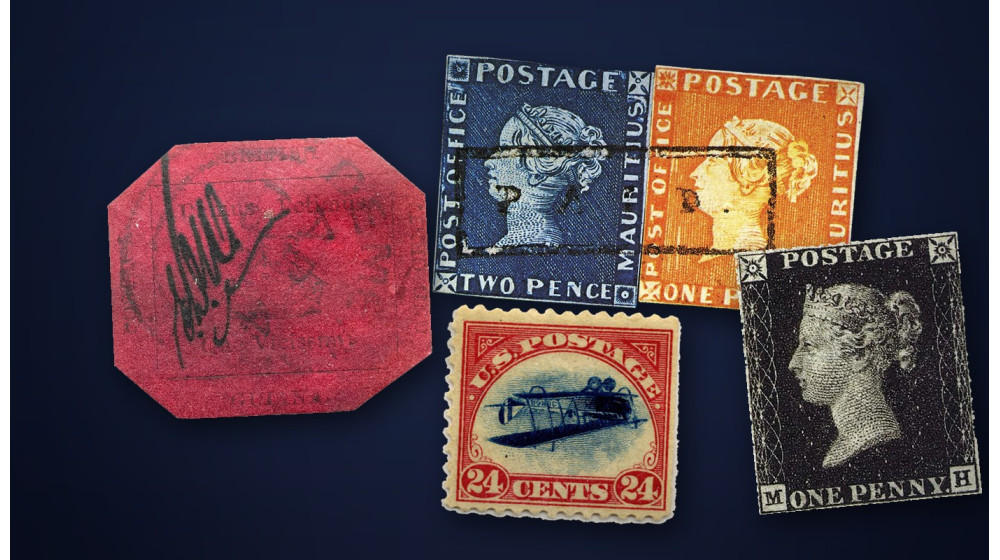
Treasures of World Philately III: rarest stamp on show in Prague
TVTomáš VeselýFounder & philatelist
📣 It opens this Saturday
The exhibition opens on Saturday 29 August and runs for just nine days, until Sunday 6 September. Anyone who wants to see the world’s most valuable stamp in person has a single week — after that it goes back into the vault.
The world’s most valuable single stamp is on show in the Czech Republic for the first time — from this Saturday. From 29 August to 6 September 2026 the Municipal House in Prague hosts Treasures of World Philately III and among more than a hundred rarities worth close to a billion Czech crowns is the legendary British Guiana One-Cent Magenta — the only surviving example in the world. This article covers what exactly will be on display, what those stamps cost and why — and how to tell whether something valuable is sitting in your own drawer.
📅
29 Aug — 6 Sep
Municipal House, Prague
💎
over 100
rarities from across Europe
💰
~40 M €
combined value
🎟️
250 CZK
admission
What you will see at the exhibition
The exhibits come from private collections across Europe and spend most of the year in bank vaults. Bringing them to Prague took the organisers — Prestige Philately Club Prague together with the Austrian Vindobona club and the Club de Monte-Carlo — several years of negotiating with owners and auction houses.
The organisers have not published a full list of exhibits — only a selection of the highlights has been confirmed in advance. These four are the ones they named:
1
British Guiana One-Cent Magenta
British Guiana · 1856
estimated at over 10 million USD
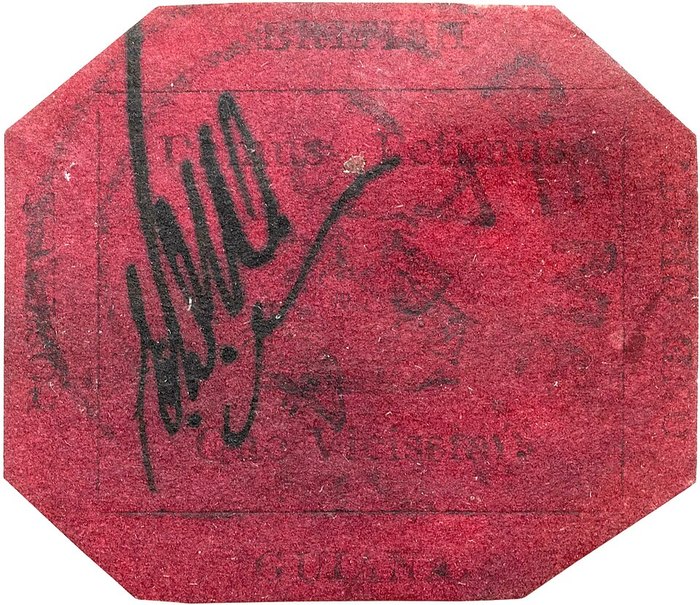
The British Guiana One-Cent Magenta of 1856 — the only surviving example in the world. Photo: Wikimedia Commons, public domain.
The only known example in the world — and the most valuable postage stamp ever sold at auction. It was an emergency measure: when the supply of stamps shipped from England ran out in Georgetown, the local postmaster had a substitute printed at a newspaper press. The stamp, with its corners cut off, weighs roughly 0.04 grams — gram for gram, the organisers say, the most valuable object ever made. It sold for 9.5 million dollars in 2014 and 8.3 million in 2021. It is the one stamp missing from the British Royal Philatelic Collection. This is its first appearance in the Czech Republic.
For the record: the outright philatelic record has been held since 2021 by the Mauritius “Ball Cover” — an 1847 invitation to the governor’s ball, which sold at the German auction house Christoph Gärtner for 10,027,800 euros. It was the first item in the history of the field to pass ten million euros. The Magenta is the most valuable single stamp, the Ball Cover the most valuable philatelic item of any kind.
2
Inverted Jenny
United States · 1918
around 2 million USD per stamp
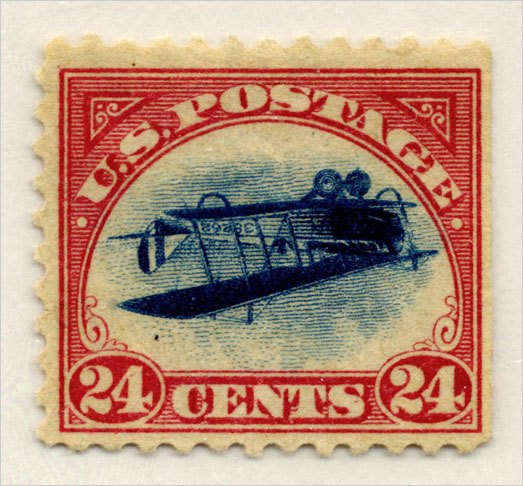
The 1918 Inverted Jenny with its upside-down aircraft. Photo: U.S. Postal Service, Wikimedia Commons, public domain.
The world’s most famous printing error: the two-colour airmail stamp went through the press a second time the wrong way up, leaving the Curtiss JN-4 flying upside down. A single sheet of one hundred reached the public — collector William Robey bought it over the counter the morning after issue. The last documented sale of a single copy was around two million dollars.
3
Penny Black in a strip of twelve
Great Britain · 1840
a unique multiple
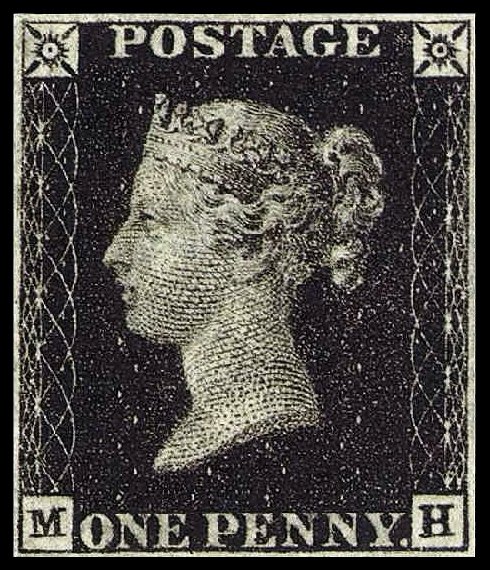
The Penny Black — the world’s first postage stamp, 1840. Photo: Wikimedia Commons, public domain.
The very first postage stamp in the world, bearing the portrait of Queen Victoria. A single copy is not rare at all — tens of millions were printed. What is exceptional is an intact strip of twelve, never shown in this country on this scale before. It is surviving large multiples that turn an ordinary classic into a museum piece.
🇨🇿 Large Penny Black multiples have a recent Prague record
The Czech market confirmed just how exceptional such an item is only recently. In March 2024 a Prague auction sold an unused block of twelve Penny Blacks for 9.1 million crowns — the highest price ever paid for a foreign philatelic item at a Czech auction. Both seller and buyer were Czech, so the block stayed in the country.
4
Mauritius “Post Paid” and a cover with three Mauritius stamps
Mauritius · 1847–1859
tens of millions of crowns
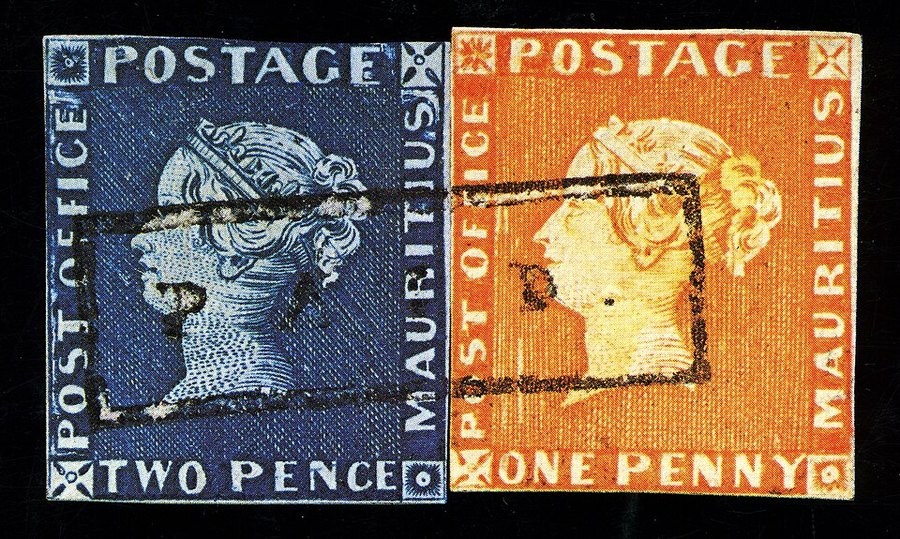
The two 1847 Mauritius POST OFFICE stamps side by side. Photo: Wikimedia Commons, public domain.
In 1847 Mauritius became the first British colony to issue its own stamps. The story that the POST OFFICE inscription was an engraver’s blunder is a myth — it was in fact the official name of the local department and the tale of an error only appeared in 1928. The exhibition brings rare blocks of the later Post Paid issue and, above all, a cover bearing three different historic Mauritius stamps— exactly the kind of cover classic collectors hunt for all their lives.
In total the exhibition is to show over a hundred rarities from private collections across Europe (some media say around sixty), so expect more than the four named pieces. Earlier editions featured the Red Mauritius, the Vermilion Mercury — the most valuable Austrian stamp — and the Czechoslovak 50/50 h postage-due error; whether any of them return this year has not been confirmed.
🔒 Security on a par with the crown jewels
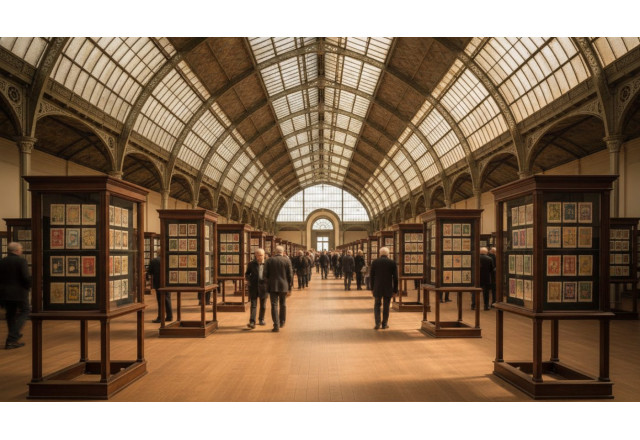
Stamps worth hundreds of millions do not simply travel. The exhibits are insured and transported under a protocol comparable to crown jewels or old-master paintings, and in the Municipal House they will be displayed in bulletproof, climate-controlled cases under permanent guard. According to Tomáš Mádl, president of the organising club, it is an honour for Prague to host objects that otherwise stay locked away in bank vaults.
When, where and how much
Treasures of World Philately III — practical information
Dates
29 August – 6 September 2026
Venue
Municipal House, nám. Republiky 1090/5, Prague 1
Opening hours
daily 10:00–18:00
Admission
250 CZK
Organisers
Prestige Philately Club Prague, Vindobona, Club de Monte-Carlo
Scale
over 100 rarities from private collections across Europe
The exhibition is open every day including weekends. Admission is a single flat rate; children under 10 and companions of disabled visitors enter free. The rarities are shown in the Art Nouveau halls of the Municipal House.
Talks and guided tours
The ticket also covers a programme worth planning around — with rarities of this calibre the commentary genuinely matters, because without context it is just a piece of printed paper.
Talk: “Is it still possible to find a rare stamp today?”
Day
Times
Saturday 29 August
12:00–12:30 and 15:00–15:30
Sunday 30 August
12:00–12:30 and 15:00–15:30
Saturday 5 September
15:30–16:00
The question everyone asks after inheriting a box of stamps.
Most slots fall at weekends and on Wednesday 2 September. Monday and Friday have a single afternoon tour — worth bearing in mind when picking your day.
🔨 Two floor auctions in the Municipal House itself
On Saturday 5 and Sunday 6 September the Municipal House hosts two floor auctions — London’s Stanley Gibbons, one of the oldest names in the trade, and the Czech Filatelie Flaška. You can bid or simply watch; a world-class floor auction is an experience in itself.
Knowledge competition
The organisers draw four winners. First prize is a sheet of personalised stamps worth 20,000 CZK, followed by a model of the Hindenburg airship worth 15,000 CZK, a black print without numerals worth 5,000 CZK and a book on investing in stamps.
And what about Czech and Czechoslovak rarities?
World unicums are the draw, but let’s be honest — most of us are really wondering whether there is something valuable in that old box from grandpa. The good news is that Czechoslovak philately has million-crown pieces of its own:
the first Czechoslovak stamp, designed by A. Mucha
Heydrich miniature sheet with a low serial number
1943
hundreds of thousands
nicknamed “the world’s most expensive miniature sheet”
These are prices realised for specific top-condition pieces, not catalogue values of ordinary copies.
🇨🇿 The PČ 1919 issue still deserves attention
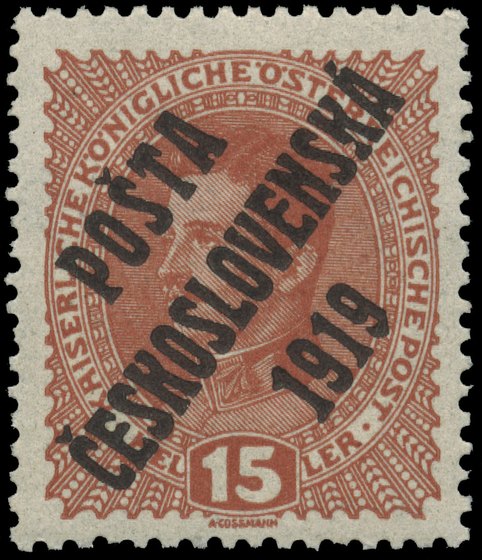
The Pošta československá 1919 overprint on an Austrian stamp — this issue produced the most valuable Czechoslovak stamp. Photo: Wikimedia Commons, public domain.
The Pošta československá 1919 overprints on Austrian and Hungarian stamps are a field where discoveries are still possible. It is the faulty and inverted overprints from this issue that hold the record for the most valuable Czechoslovak stamp. Interest is not only domestic: last June the Zurich house Corinphila sold an entire collection of PČ 1919 overprints for 70,000 Swiss francs — seventy times the opening price. Ordinary copies, meanwhile, cost only a few crowns — our PČ 1919 range is in the shop.
What actually makes a stamp valuable
The price of a rarity never rests on age. Four things decide it:
Factor
What it means
Example from the exhibition
Print run and survival
how many were made and how many survive
One-Cent Magenta — a single copy worldwide
Production error
inverted overprint, inverted centre, wrong colour
Inverted Jenny, the 50/50 h error
Condition
perforation, gum, centring, cleanliness
Penny Black in an intact strip of twelve
Documented provenance
expert mark, certificate, collection history
pieces from famous collections carry a premium
How to tell whether you have something valuable at home
1
Do not glue, wash or remove anything from its cover
The most common way to destroy value is trying to “improve” a stamp. A cover — the stamp on its original envelope — is often worth more than the stamp alone.
2
Look for errors
A shifted or inverted overprint, a missing colour, a double impression. Deviations from the norm are what turn an ordinary stamp into a collector’s item.
3
Check the catalogue number
In our online stamp catalogues you can look up the issue, the catalogue number and an indicative price by condition.
4
Get a certificate for valuable pieces
An expert mark or certificate significantly improves saleability of higher-value items. The Union of Czech Philatelists offers free indicative valuations at the Sběratel fair.
Treasures within reach of an ordinary collector
A stamp worth a quarter of a billion is a fine spectacle, but you will not build a collection on it. Our range holds pieces with a story and genuine collector value that still fit a real budget:
Over 28,000 items from around the world, our own catalogues with prices and AI stamp recognition from a photograph. You can keep a collection with us free of charge, even if you never buy anything.
When and where is the Treasures of World Philately III exhibition?
From 29 August to 6 September 2026 in the Art Nouveau halls of the Municipal House on nám. Republiky in Prague 1, open daily from 10:00 to 18:00. Admission is a flat 250 CZK; children under 10 and companions of disabled visitors enter free.
What is the most valuable stamp in the world?
The most valuable single stamp is the British Guiana One-Cent Magenta of 1856 — one copy exists; it sold for 9.5 million dollars in 2014 and 8.3 million in 2021. The most valuable philatelic item of any kind is the Mauritius Ball Cover of 1847, which sold for 10,027,800 euros in 2021. The Magenta will be shown in the Czech Republic for the first time at the Prague exhibition.
What is the most valuable Czech or Czechoslovak stamp?
The four-crown value of the Pošta československá 1919 issue with an inverted overprint on ribbed paper — the only known example in the world. In March 2018 it sold in the Municipal House in Prague for 7.8 million crowns hammer, roughly 9.4 million with the buyer’s premium. It is also the highest price in the history of Czech philatelic auctions.
How do you recognise a valuable stamp?
It comes down to a low surviving quantity, a production error (inverted overprint, inverted centre, wrong colour), good condition and documented provenance. Age alone does not create value — ordinary 19th-century stamps are usually cheap.
I have old stamps at home. How do I find out what they are worth?
First leave them as they are — do not soak them off covers or clean them. You can look up the catalogue number and an indicative price in our online catalogues; for valuable pieces an expert certificate is worth it. The Union of Czech Philatelists offers free indicative valuations at the Sběratel fair.
Tags:#treasures of world philately III#world's most expensive stamp#British Guiana One-Cent Magenta#Prague stamp exhibition#Inverted Jenny#Penny Black#rare stamps#philately Prague 2026