New Plate and Type Registers in Digital Collection
Some time ago, we showed you how artificial intelligence can crop and identify each stamp from a single photo of an album page, as well as how to maintain a digital catalogue of your collection with prices and value. Today, we add a third step that will be appreciated especially by specialised collectors: the register of printing plates, types, and omnibus issues. In the digital collection on Znamky.cz, each stamp now has its own matrix: you record the plate position, type, perforation, and watermark position with a click, and immediately see what you are missing for a plate reconstruction or a complete set of types. Whatever is missing, you can look up in the e-shop with a single button.
In the article, we will go through what the register can do, how records are created, and finally, we will provide an overview of the latest features in the Znamky.cz mobile app up to version 1.2.58.
What is a printing plate register and why collectors keep it
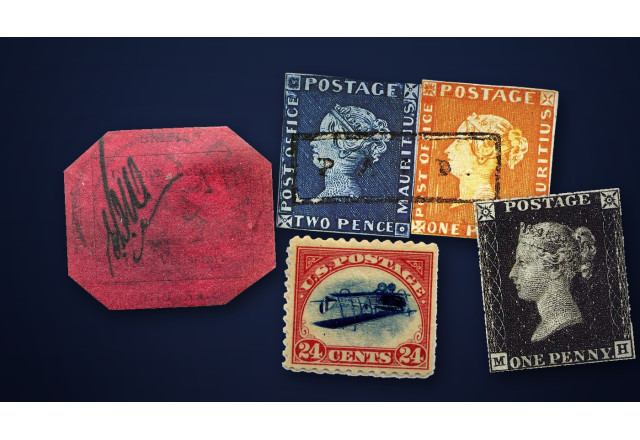
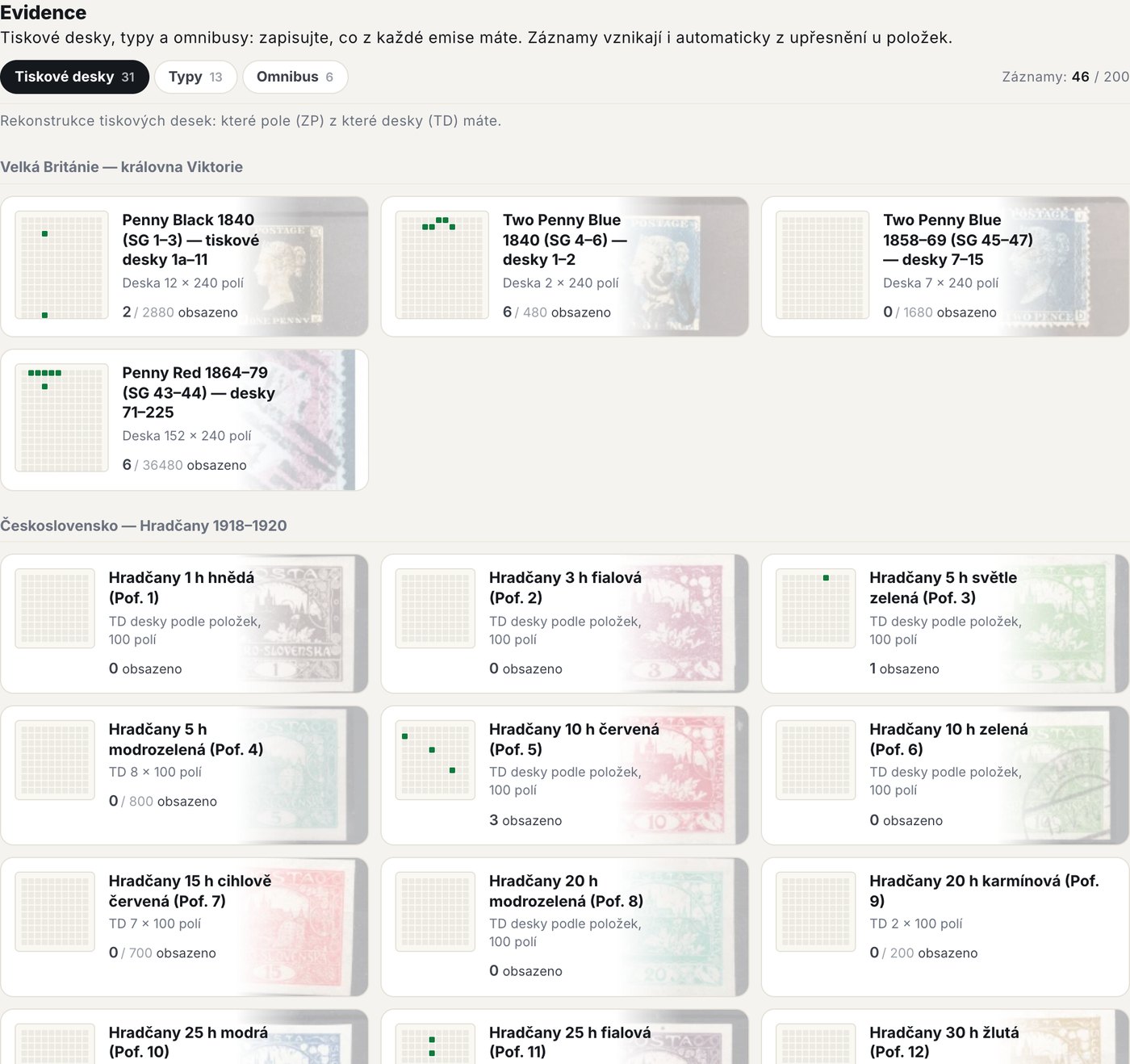
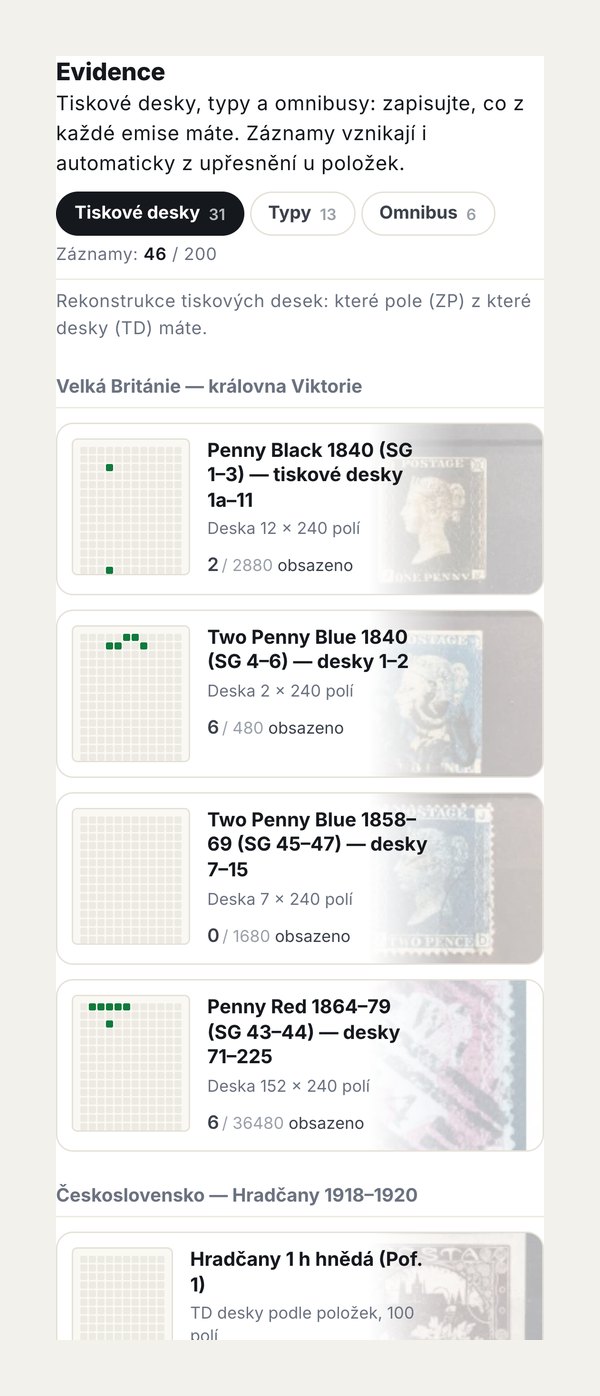
Classic issues were printed from several printing plates (TD), and each plate contained dozens to hundreds of stamp positions (ZP). For example, the Hradčany issue has 100 positions on a plate (10 × 10), while the British Penny Black has 240 positions marked by control letters AA to TL. Each position can often be identified by a minor plate flaw (DV) or type of design. Thus, a specialised collection naturally transforms into a plate reconstruction: the goal is to obtain every position from a given plate.
Paper tables and notebooks, in which such reconstructions were recorded, have two disadvantages: they do not show you an image and do not advise you on what to acquire next. This is precisely what we wanted to change.
Three Types of Registers: Plates, Types, and Omnibus
You can find the register in your account under the Collections and Exhibits section in the Register tab. The directory divides it into three parts:
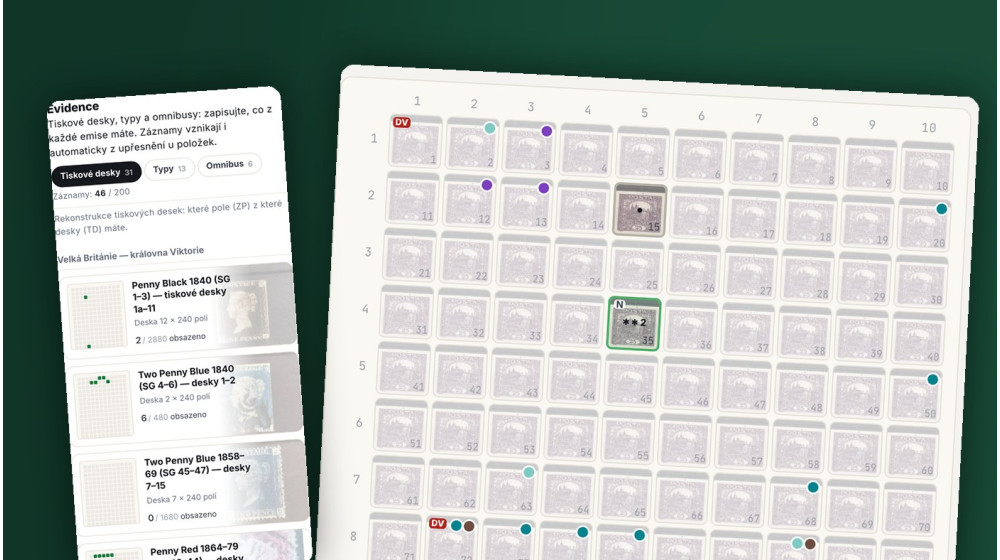
- Printing Plates: plate reconstruction according to stamp positions. Currently, Hradčany Pof. 1–26 and British classic issues Penny Black 1840 (plates 1a–11), Two Penny Blue 1840 (plates 1–2) and 1858–69 (plates 7–15), and Penny Red 1864–79 (plates 71–225).
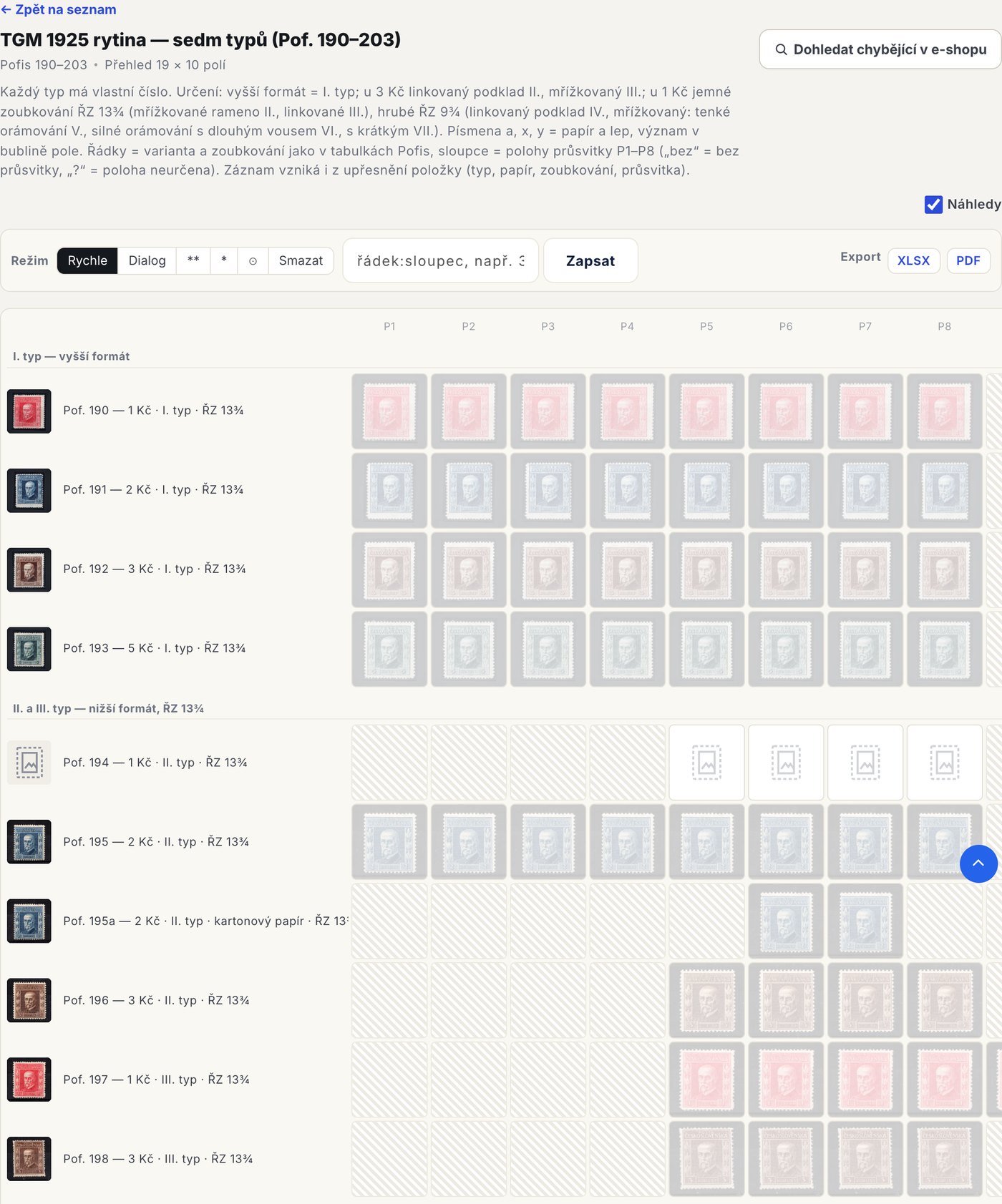
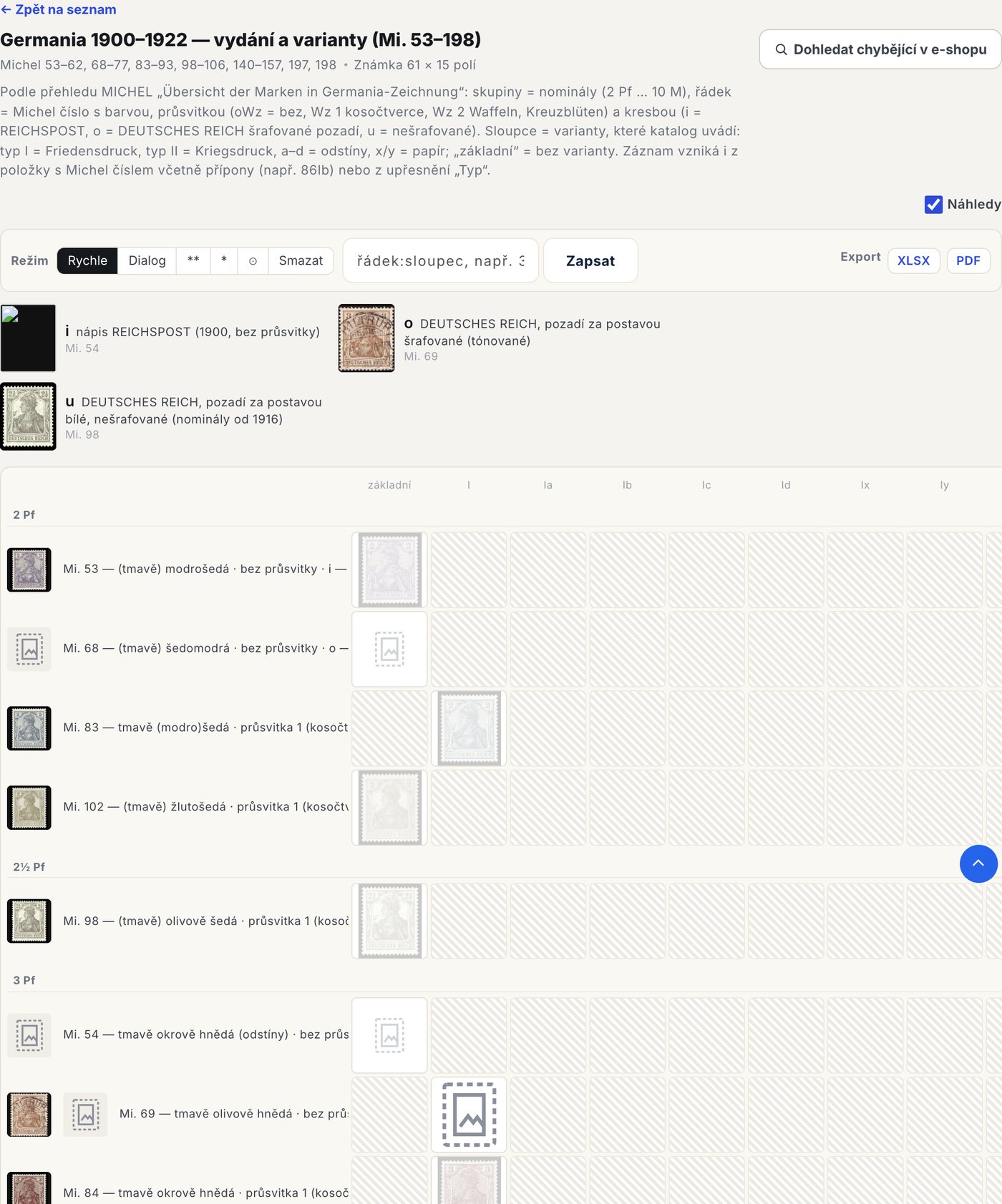
- Types and Variants: matrix stamp × type. Hradčany including joined types, Hradčany with overprint (postage due DL, SO 1920, SPECIMEN, airmail), Czechoslovak Post 1919 by individual stamps, issues 1920–1927 (Red Cross, Agriculture and Science, 1923 Jubilee, TGM 1925 in both neotypy and engraving, altered design 1926, Castles, Landscapes and Towns, Prague and Tatras) and German Germania 1900–1922 according to Michel.
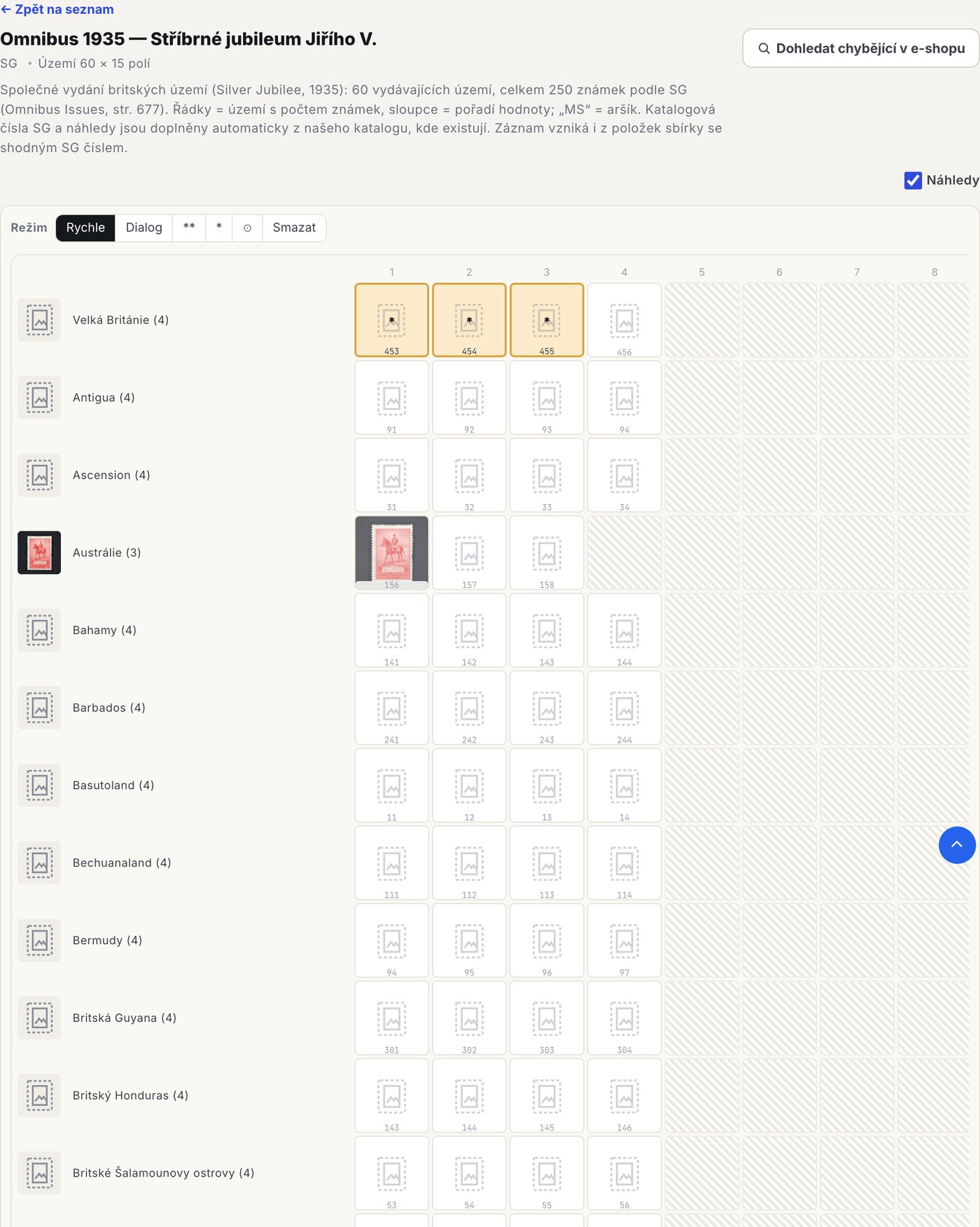
- Omnibus: joint issues of British colonies by territory and SG numbers. Silver Jubilee 1935, Coronation 1937, Victory 1945–47, Silver Wedding 1948, 75th Anniversary of the UPU 1949, and University of the West Indies 1951.
Printing Plates: 10 × 10 Sheet with Plate Flaws and Types by Position
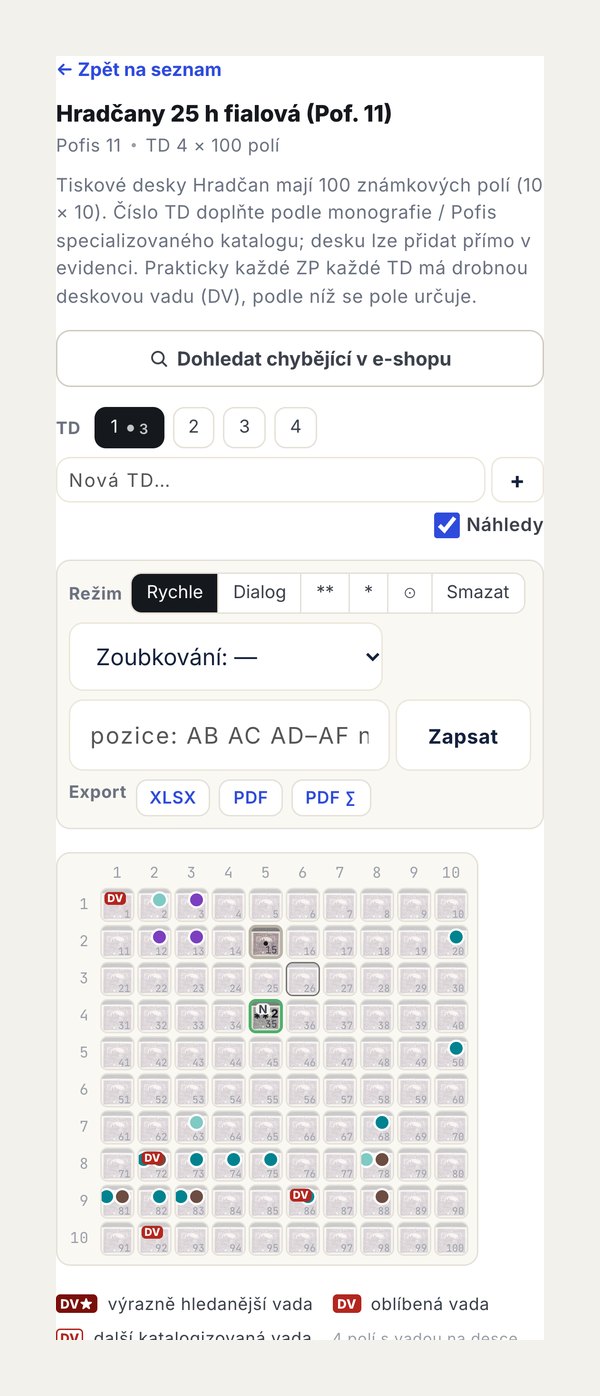
Take a look at the Hradčany 25 h violet (Pof. 11) and you'll see the sheet exactly as it appeared on the plate: 10 rows, 10 columns, with each position numbered. At the top, you can switch between individual plates and add more if listed in the catalogue or monograph.
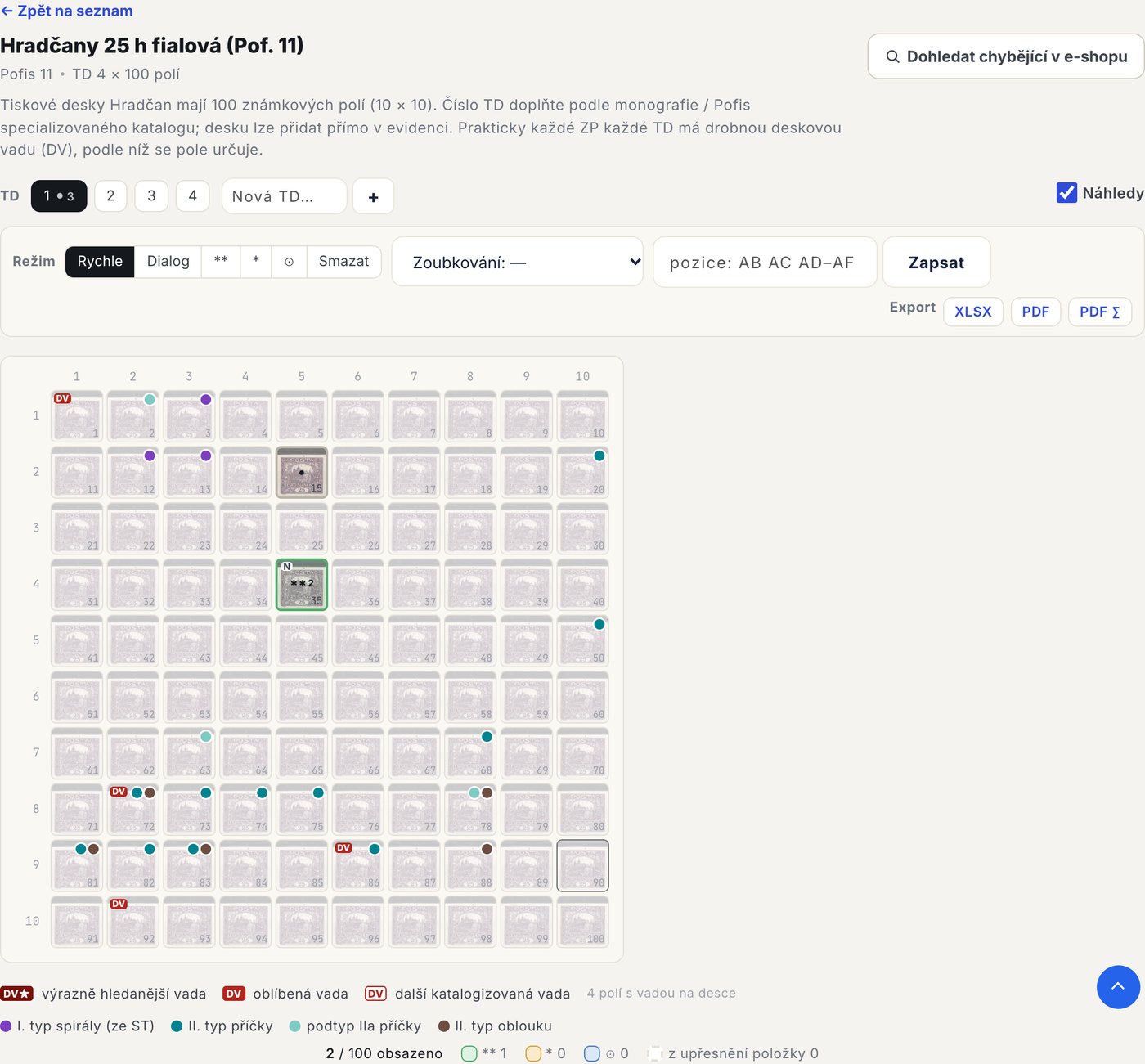
We've incorporated what is known about Hradčany from literature into the sheet:
- Plate flaws by position as stated in the philatelic literature. Across all 26 values, this totals 326 positions with described flaws. The DV label has three levels depending on how sought after the flaw is among collectors. We do not list prices; however, the level will indicate which position to watch out for.
- Design types by position: spiral, bar, arc, and frame types including joined types according to the Pofis catalogue, displayed as coloured dots directly on the position. A position may have two types at once.
- Perforation as an additional dimension of the record, only the letters that the catalogue actually lists for the given value are offered.
- Quality of the stamp in the position: ** mint never hinged, * hinged, ⊙ used.
You can record positions with one click (mode **, * or ⊙), through a detailed dialog, or in bulk: enter something like "12 15 31–35" in the "position" field and press Record. An entry with your own photograph will appear as a preview in the position, while other positions show a reference image of the stamp. You can export the entire plate to XLSX or PDF.
Types and Variants: Hradčany, PČ 1919, TGM and Germania
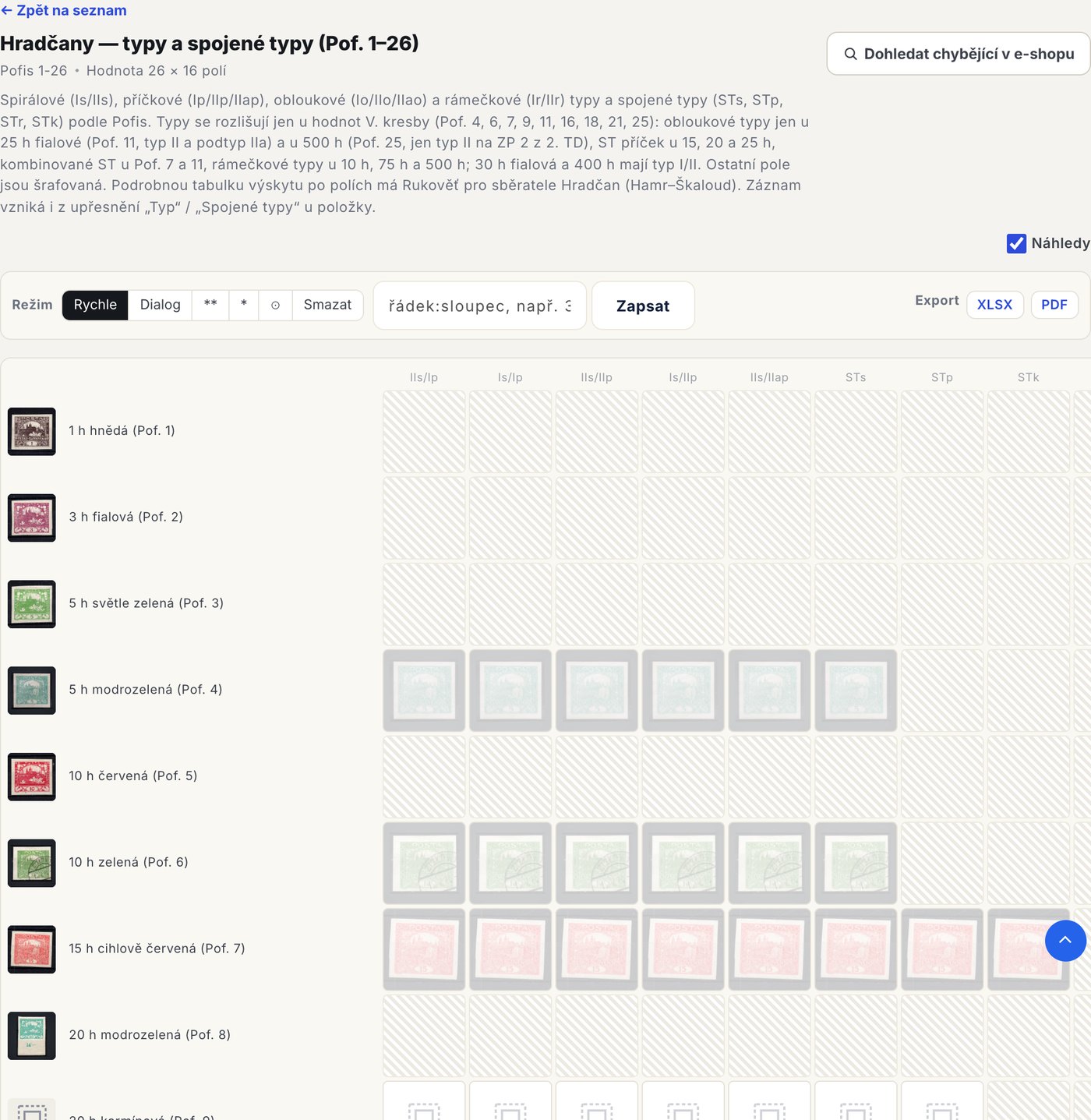
The register of types functions as a matrix: rows represent stamps, columns represent types and variants. Shaded fields indicate combinations unknown to the catalogue, so you cannot mistakenly record them. For Hradčany, types are found only for values of the Fifth Drawing (Pof. 4, 6, 7, 9, 11, 16, 18, 21, 25), joined types for 15, 20 and 25 h, and frame types for 10 h, 75 h and 500 h.
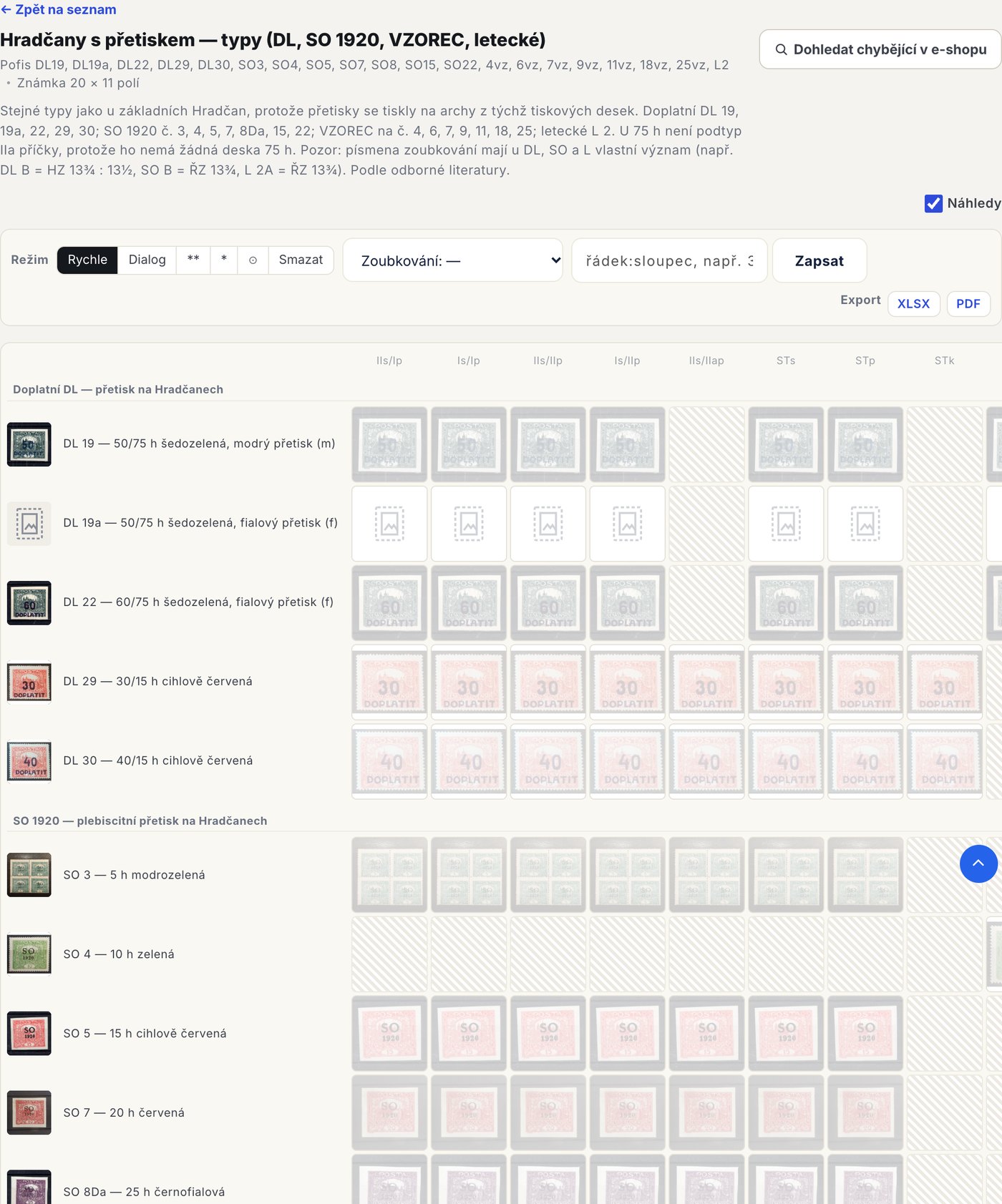
The same types apply to Hradčany with overprint, as the postage due DL, SO 1920, VZOREC and airmail L were printed on sheets from the same plates.
Czechoslovak Post 1919 has its own register for individual stamps: 107 stamps in 24 series, each with only overprint types I to IV, as listed in the catalogue. For TGM 1925 in engraving, there are seven drawing types, each with its own Pofis number, and letters a, x, y for paper and gum.
For collectors of Germany, Germania 1900–1922 is prepared according to the MICHEL overview: rows Mi. 53–198 with colour, watermark and drawing (i = REICHSPOST, o = hatched background, u = unhatched), columns type I and II, shades a–d and papers x/y. In this language version of the site, Czechoslovak registers show Michel numbers next to Pofis numbers.
Watermarks and Papers: Castles, Landscapes and Towns and Prague, Tatras
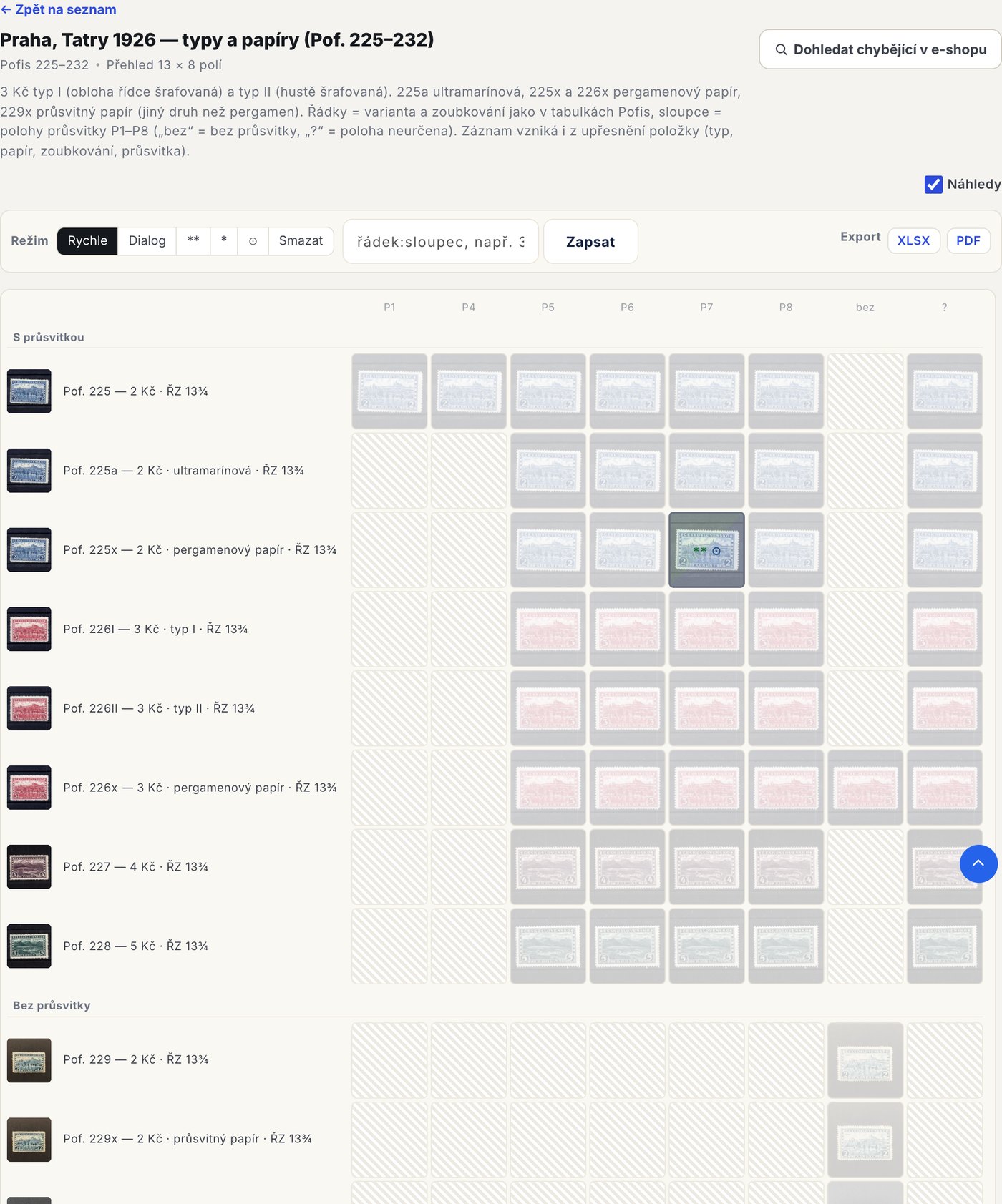
For issues with the Linden Leaves watermark, the register is organised as tables in Pofis: each row represents a variant with its perforation (for the 3 Kč Prague, Tatras type I with sparsely hatched sky and type II with densely hatched sky, for the 2 Kč shade 225a and parchment paper 225x), columns are the watermark positions P1 to P8. Numbers without watermark have a single "without" field, and if you do not yet know the position, you record the item in the "?" column. A record is also automatically created from a collection item where you fill in the type, paper, perforation or watermark.
Omnibus of British Colonies by Territories
Omnibus issues are collected as a whole: one anniversary, dozens of territories, each with three to four values. The register lists territories in rows and the order of values in columns; hovering over an entry reveals the country, SG number, and denomination. For the Silver Jubilee 1935, there are 60 territories and 250 stamps according to Stanley Gibbons.
How Records Are Created
- By clicking in the sheet or matrix: The quickest method for collectors maintaining a reconstruction without photographs.
- Automatically from a collection item: When you specify details for a stamp in your collection (printing plate, position in the sheet, type, perforation, or watermark), a record in the register is created automatically and includes a photograph of the item.
- In bulk: You can enter a list of positions at once, for omnibus issues the entire territory.
The Find missing items in the e-shop button will list what we currently have in stock from the given issue for the open register. Where we do not have our own photograph, a freely available image from Wikimedia Commons (only public domain and CC0) will be added as a preview.
News in the mobile app up to version 1.2.58
The Znamky.cz mobile app has undergone several updates since the summer. iPhone users moved directly from version 1.2.44 to 1.2.58, so all the changes listed below are new to them at once.
- AI recognition with TOP 5 matches: alongside stamps from our shop, there is also a "Catalogue Only" section with catalogue prototypes (number, country, year, series) for stamps we do not currently sell. The catalogue number is based on the country's main catalogue: Pofis for Czechoslovakia and the Czech Republic, Michel for Germany and Austria.
- Warning on interchangeable variants: similar stamps, perforation and watermark variants with clickable codes are shown on the proposal, plus the type and condition of the item and the price level in dots.
- Trial without login: AI recognition three times for free on a device, save the result after registration.
- Choice of item type under the camera (1.2.56): stamp, pair or strip, block of four, FDC, cover, postal stationery, coupon, banknote, sports card. Without a choice, the app determines the type itself.
- New collection list (1.2.47): number of items, value estimate and average rarity at the top, filters by country and condition, price level for each line. Item detail has a Determination card, other catalogues (Pofis, Michel, Scott, SG) and Similar + AI tools, Perforation Gauge and Edit.
- Statistics and folders: graph of value development over time, folders with totals, status of a draft order on the home screen.
- Market indices: tracking stamp prices from auctions and sales (12-month median and trend), custom indices and a list of watched stamps.
- AI identification also for banknotes, coins, cards, and postal stationery: reads country, denomination, year, and series from a photo, for banknotes suggests Pick number and finds variant by year.
- Little things that delight (1.2.57 and 1.2.58): larger guide frame in the camera, which can be turned off; proposals show country and denomination; statistics update immediately after saving; value estimate also for Austria; new home screen with digital collection; shop notifications above the top menu.
The register of plates and types is currently available on the website; we will add it to the app in one of the upcoming versions. However, the web collection is fully usable in the mobile browser, including sheets.
Unlimited Register with Znamky+
Free Account allows you to register 200 entries, which is sufficient for one Hradčany plate or to try out an omnibus. However, if you are reconstructing more plates or tracking types of an entire issue, you will quickly encounter this limit.
Znamky+ Membership completely removes this limit and additionally offers an unlimited collection and want list, 10,000 AI identifications per month, bulk import and export of collections, a 10% discount on every purchase, and 10% cashback in the form of credit.
What We Are Planning Next
- Expanding the register of types with additional issues (Czechoslovakia 1929–1939, Slovakia 1939–1945, Protectorate) and adding more countries to the register of plates.
- Register in the mobile app with the same sheet as on the website.
- Adding images of watermarks and types where the template is currently missing.
Is there something missing for your register? Additional issues, countries, types, or another method of entry: write to us, we are happy to further expand the register according to what collectors are actually reconstructing.
How to Start
- Log in to Znamky.cz or create a free account.
- In the Collections and Exhibits section, open the Register tab and select a plate, types or omnibus.
- Click into the fields, or fill in details for stamps in your collection and let the records create themselves.
- For missing items, search using the button in the e-shop or save them to your want list.
Taking photos and adding items is still most convenient in the Znamky.cz mobile app for Android and iPhone.
Frequently Asked Questions
Is the printing plate register free?
Yes, every registered user has 200 records available for free. Znamky+ and ZnamkyAI offer unlimited register access.
Where do plate flaws and types by position come from?
From the Pofis catalogue and specialised literature on Hradčany. If the literature does not include a table by position, the positions remain unmarked and the entry is up to you.
Do I need to have the stamps photographed?
No, you can enter positions without a photograph. However, if the entry is created from a collection item with a photo, a preview of it will be displayed in the position.
Does the register work for countries other than Czechoslovakia?
Yes, it includes British classic issues, British colonial omnibus issues, and German Germania. We add other countries based on interest.
Will I see the register in the mobile app?
Currently, it is available on the website, which also works in a mobile browser. We will add the register to the app in one of the upcoming versions.